
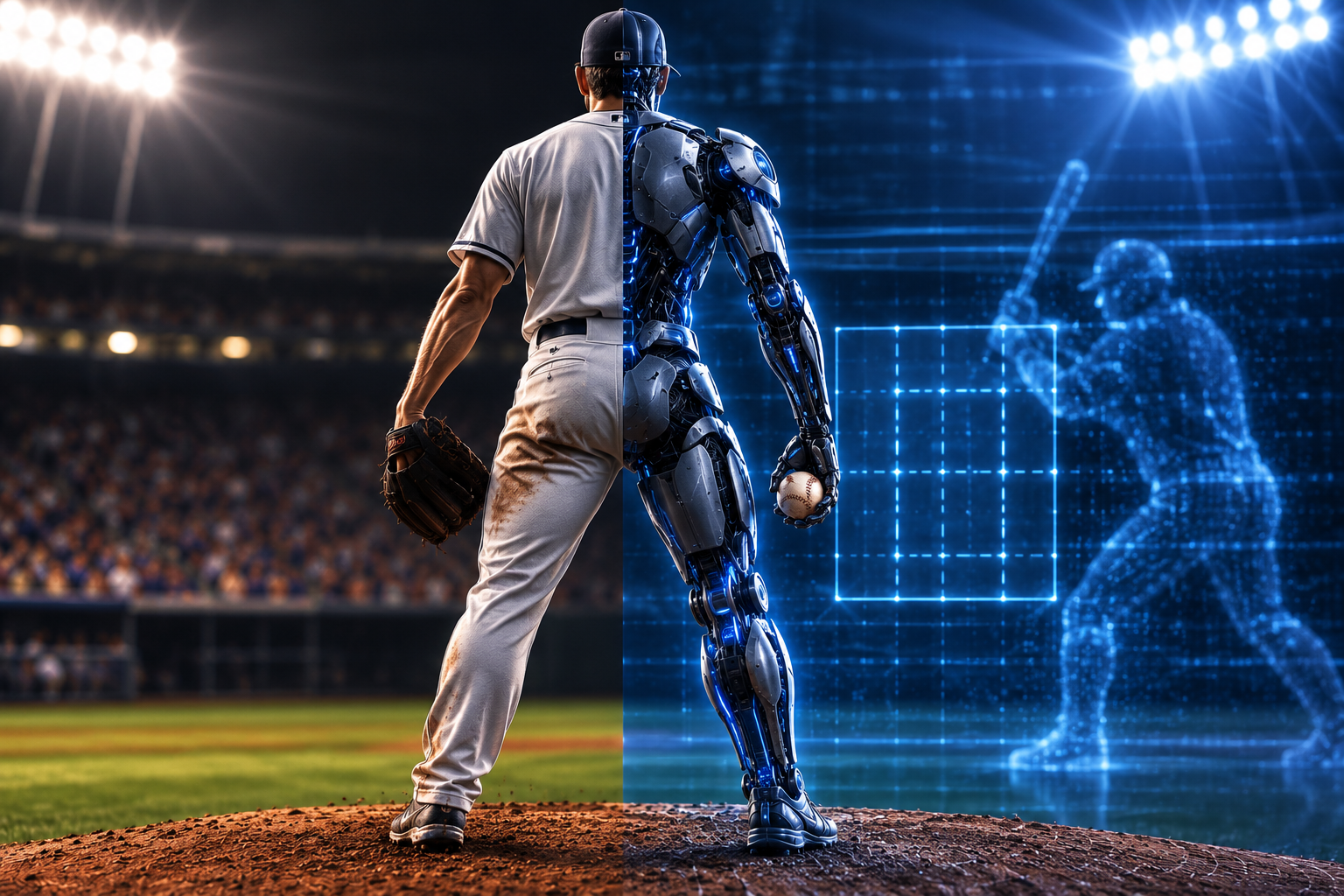
Baseball has always been a game of adjustments.
For more than a century, the battle between a pitcher and a hitter was one of the purest competitions in sports. Every at-bat was a chess match. Every inning was a series of adjustments. Great pitchers didn’t dominate because someone handed them a report filled with percentages, they dominated because they understood the game, trusted their instincts, and knew how to read the hitter standing 60 feet, 6 inches away.
Today, that art is slowly disappearing.
Modern baseball has become consumed by analytics, heat maps, spin rates, launch angles, expected batting averages, and scouting reports that often dictate every pitch before the catcher even puts down the sign. While analytics have undoubtedly made teams smarter and helped players improve, they’ve also created an environment where many pitchers are expected to execute a pre-determined script instead of trusting what they’re seeing in the moment.
Somewhere along the way, baseball stopped trusting the pitcher.
The greatest pitchers in history weren’t simply blessed with elite arms, they were masters of adaptation.
Greg Maddux could dismantle a lineup without overpowering hitters because he understood how each batter was trying to attack him. Tom Glavine lived on the corners and constantly adjusted throughout the game. Pedro Martínez knew exactly when to challenge a hitter and when to exploit his impatience. Randy Johnson had overpowering stuff, but he also understood sequencing, confidence, and timing.
Those pitchers didn’t need someone telling them what to throw every pitch. They created their game plan while the game was unfolding.
Every hitter is different. Every swing feels different. A batter may look uncomfortable one inning and completely different the next. Great pitchers recognize those changes immediately because they’re the ones standing on the mound, watching every movement, every reaction, and every adjustment. That instinct cannot be measured by a computer.
A pitcher knows when his slider has exceptional bite. He knows when his fastball has extra life. He knows when his changeup just doesn’t feel right that night. Those aren’t statistics, their instincts developed over thousands of pitches.
Yet today’s game often asks pitchers to ignore those instincts.
Instead, they’re expected to trust the scouting report because the numbers suggest a certain pitch has a higher probability of success. Sometimes those numbers are absolutely correct. But sometimes the pitcher standing on the mound knows more about what’s happening in that moment than anyone studying a tablet in the dugout.

That’s where baseball has become more mechanical than human.
Pitchers today are expected to maximize velocity, maintain elite spin rates, repeat mechanically perfect deliveries, hit precise locations, follow detailed scouting reports, and work under the pitch clock, all while facing the best hitters in the world. The game has become increasingly robotic.
Instead of allowing pitchers to solve problems naturally, many are taught to repeat a process over and over until the numbers say it’s correct.
But baseball has never been played inside a spreadsheet. It’s played by human beings. No algorithm can measure confidence. No heat map can detect hesitation in a hitter’s swing. No percentage can fully explain what a pitcher feels when he realizes his curveball is untouchable that night, or when he knows it’s time to abandon it because he simply doesn’t have command of it. Those are decisions that belong to the pitcher.
Another concern is how physically demanding the modern game has become.
Today’s pitchers are throwing harder than ever before. Organizations value velocity, and young pitchers spend years trying to reach 97, 98, or even 100 mph because that’s what gets noticed. Every pitch is often thrown with maximum effort, putting tremendous stress on the arm.
At the same time, pitchers are expected to work at a quicker pace because of the pitch clock. Many have adjusted well, and the faster pace has undoubtedly improved the viewing experience for fans. But the demands placed on pitchers today are unlike any previous generation.
Whether the pitch clock itself contributes to injuries remains open to debate.
What isn’t debatable is that pitchers are being asked to do more than ever before, under constant time pressure.

It’s fair to ask whether all of those demands are changing the very nature of pitching.
This isn’t an argument against analytics. Analytics belong in baseball. The information they provide has helped players improve, strengthened scouting, and given organizations valuable insight that previous generations never had. The problem begins when the numbers stop being a resource and start becoming the decision-maker. The best pitchers have always been more than throwers. They’re competitors. They’re problem solvers. They’re artists. The greatest ones don’t just execute a game plan, they create one with every pitch they throw.
Maybe baseball doesn’t need fewer analytics. Maybe it simply needs to trust the people standing on the mound again. Because sometimes the pitcher knows something the computer doesn’t.
And perhaps that’s the one statistic that can never truly be measured.


