Legends of Yesteryear
Legends of Yesteryear: Mets David Wright, “The Captain,” Immortalized in Queens

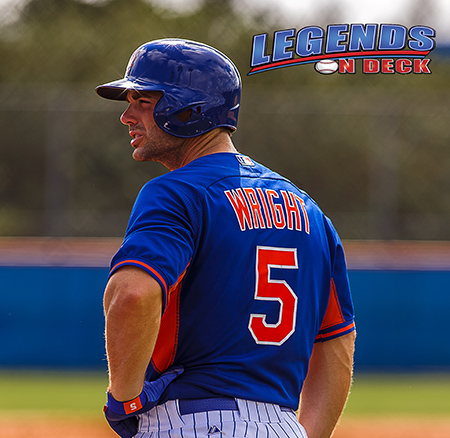
On July 21, 2004, David Wright made his Major League debut with the New York Mets. Nearly a decade later, in March 2013, the Norfolk, Virginia native was named the fourth captain in franchise history, joining the legendary ranks of John Franco, Gary Carter, and Keith Hernandez.
This past Saturday, July 19, 2025, the Mets paid tribute to their beloved third baseman by inducting him into the Mets Hall of Fame and retiring his iconic No. 5 — a number that will hang in the rafters forever.
A career that started with great promise ended without the one thing Wright wishes he could have delivered: a World Series crown.
But even that missed opportunity can’t diminish what Wright meant to the Mets, their fans, and the game.
Wright was ranked the No. 21 overall prospect in 2004, and his arrival to the Mets sparked a new era of winning baseball. New York finished the ’04 season in fourth place, 20 games under .500, but the 2005 season saw the Mets rebound to an 83–79 record and a third-place finish in the NL East.
This barehanded catch by David Wright never gets old 🤯 pic.twitter.com/oNOwPokQRc
— MLB Vault (@MLBVault) December 19, 2020
As the Mets worked to rebuild into a competitive team, David Wright was establishing himself as one of the league’s premier sluggers. In 2005, Wright knocked the ball all over the field, collecting 42 doubles, a triple, 27 home runs, and 102 RBIs in his first full season in the majors.
The 2006 season was a magical one for Wright and the Mets, as they captured the NL East title for the first time since 1988. Wright delivered a breakout performance, earning the first of his seven All-Star selections. He racked up 40 doubles, five triples, 26 home runs, and 116 RBIs while anchoring the middle of a star-studded lineup. That year’s Mets roster featured standout names like Paul Lo Duca, Carlos Delgado, Jose Valentin, Jose Reyes, Cliff Floyd, and Carlos Beltran.
The unfortunate part of that season was that the Mets came within a game of the World Series but fell to the eventual champs, the St. Louis Cardinals.
The Mets wouldn’t return to the postseason again until Wright’s first World Series appearance in 2015. He endured the Mets’ decline after the 2006 season, including two second-place finishes followed by six consecutive sub .500 seasons.
In the years leading up to 2015, Wright continued to place himself as one of the game’s top hitters. He appeared in five consecutive All-Star Games (2006–2010), recorded back-to-back 30-home run seasons, and reached as high as 34 home runs in 2008, while driving in 124 runs. Not only could he swing with the best of them, he also was a great defensive third baseman, winning two Gold Gloves in his career (2007/2008).
Although the Mets enjoyed the best of Wright for much of his 14-year tenure, it wasn’t until his time in the game was nearing its end that the organization finally returned to the Fall Classic.
In 2011, Wright suffered a stress fracture in his lower back, a serious injury that would eventually derail his career. He played in just 102 games that year, but in 2012, he bounced back with a strong season, appearing in 156 games and returning to All-Star form.
After a late-season hamstring injury in 2013 cost him significant time, Wright rebounded in 2014, but lingering injuries began to sap his power. That year, he failed to hit double-digit home runs for the first time in his career.
The Captain, forever. 5️⃣ pic.twitter.com/q34KqAw83a
— New York Mets (@Mets) July 19, 2025
At the midpoint of the 2015 season, the Mets sat in second place in the NL East. But a season-changing trade soon turned them into serious contenders. The team sent pitching prospects Michael Fulmer and Luis Cessa to the Detroit Tigers in exchange for slugger Yoenis Céspedes. Within a month, the Mets had surged into first place and were charging toward the postseason.
The one thing missing on most nights, however, was Wright. He had been diagnosed with spinal stenosis in mid-April, a condition that would significantly limit his time on the field.
The Captain returned to the lineup on August 24, and while he was a shadow of his former self physically, his presence in the clubhouse and on the field was just as impactful as any home run he could hit.
Wright finally reached the World Series and made the most of the moment, launching a home run in his very first Fall Classic at-bat at Citi Field — a truly poetic moment in a storybook career.
New York wouldn’t add another ring to the trophy case in 2015, and as incredible as it would have been for the Captain to bring a championship back to Queens, David Wright’s remarkable career as a homegrown Met still left an enduring legacy—one built on loyalty, leadership, and excellence.
On September 29, 2018, Wright took the field one final time as a New York Met, starting at third base. Then, in the top of the fifth inning, he walked off to a thunderous, emotional ovation, marking the heartfelt end of a beloved career.
Following Saturday’s Hall of Fame induction and number retirement ceremony at Citi Field, the Captain’s legacy is forever cemented. Moving forward, no matter who wears the ‘C’ next, no homegrown player will ever forge the same unique bond or command the admiration that David Wright did with Mets fans.
? “The Wright Way”?
Honoring David Wright and the retirement of his number 5??
Making this was an emotional rollercoaster. #Mets #LGM #DavidWright #TheWrightWay pic.twitter.com/fE32vKKQjP
— Jordan Simpson (@jrsimpsonmusic) July 19, 2025


